Building a house in Pakistan while living in the UK, UAE, Saudi Arabia, Europe, North America or Australia can feel difficult.
You may own the plot, have the budget and know what kind of house you want.
But you are thousands of kilometres away from the construction site.
That creates an obvious question:
Can an overseas Pakistani build a house in Islamabad without being physically present throughout construction?
Yes—but only if the project is structured for remote management from the beginning.
The biggest issue is not distance itself. The real risks are unclear construction scope, weak documentation, unverified plot status, advance payments without progress, material substitutions, poor site supervision, design changes without approval, inconsistent reporting, and too many contractors with no single accountable person.
A professionally managed project can reduce these problems through approved drawings, a detailed BOQ, milestone-linked payments, documented material selections, regular progress reports and a named engineer responsible for the site.
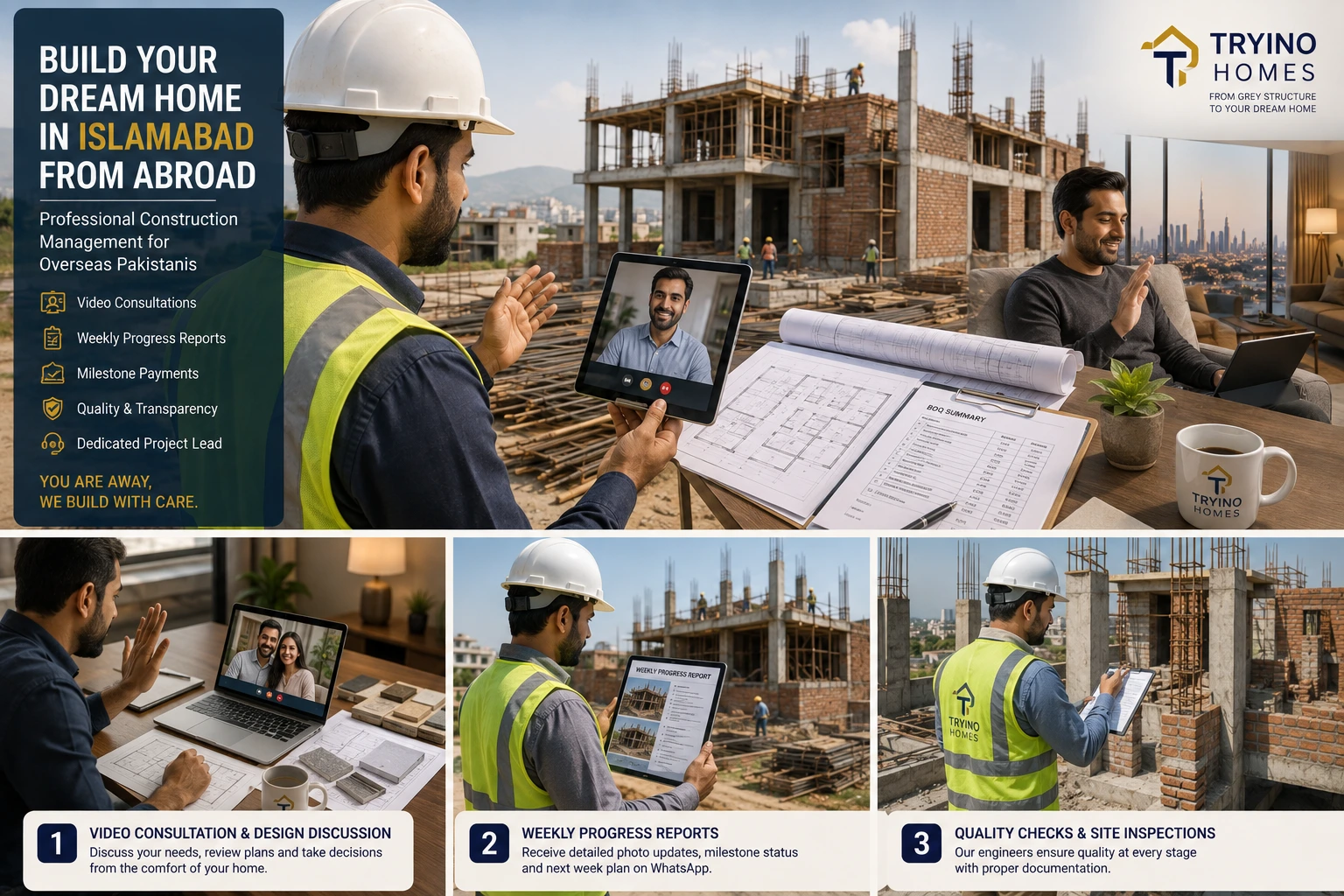
Tryino Homes runs a remote construction process built specifically for overseas Pakistani clients in Islamabad and Rawalpindi. Roughly half of Tryino's clients live outside Pakistan, and weekly photo reports, milestone payments and dedicated WhatsApp communication are standard for every overseas project.
Here is how the process should work.
Why Building From Abroad Needs a Different Construction Process
A homeowner living in Islamabad can visit the site several times a week. An overseas owner cannot. That means the project needs to replace physical presence with documentation and accountability.
Instead of relying on:
"Don't worry, the work is going fine."
you should be able to see what was completed, what materials were used, which milestone has been reached, what payment is due, what work begins next, which decisions require your approval, and whether construction matches the drawings.
A remote project should therefore be designed around evidence rather than verbal assurances.
The Remote Construction Model at a Glance
A well-managed overseas construction project can follow this sequence:
| Stage | What the Overseas Owner Should Receive |
|---|---|
| Plot Verification | Plot, possession and utility status confirmation |
| Initial Consultation | Video call covering budget, needs and timeline |
| Design | Architectural drawings and revisions |
| Engineering | Structural and MEP drawings |
| BOQ | Defined quantities, specifications and scope |
| Contract | Price structure, milestones and responsibilities |
| Mobilisation | Site setup and construction schedule |
| Construction | Regular site supervision and reporting |
| Payments | Invoices linked to visible milestones |
| Material Selection | Documented approvals before procurement |
| Quality Checks | Inspection records and progress evidence |
| Handover | Snag list, rectification and final completion |
The exact process varies by project, but these controls are especially important when the owner is abroad.
Step 1: Verify the Plot Before Spending on Construction
Before selecting tiles, elevations or kitchens, confirm that the plot is actually ready to build on. This is particularly important for overseas Pakistanis because property may have been purchased years earlier or through family members, agents or investors.
Verify the society, block and plot number; ownership, possession and transfer status; utility availability and road access; and the society's current construction requirements.
Tryino Homes' overseas-owner process starts by confirming the plot, possession and utility status — before quotation or mobilisation.
Plot files and possession plots are not the same thing
A property file, allocation or investment product does not automatically mean construction can start. For an overseas owner, this distinction matters enormously. Before committing money to house construction, make sure the exact plot is possession-ready and legally/buildably available under the relevant society's current requirements.
Step 2: Start With a Video Consultation and Clear Brief
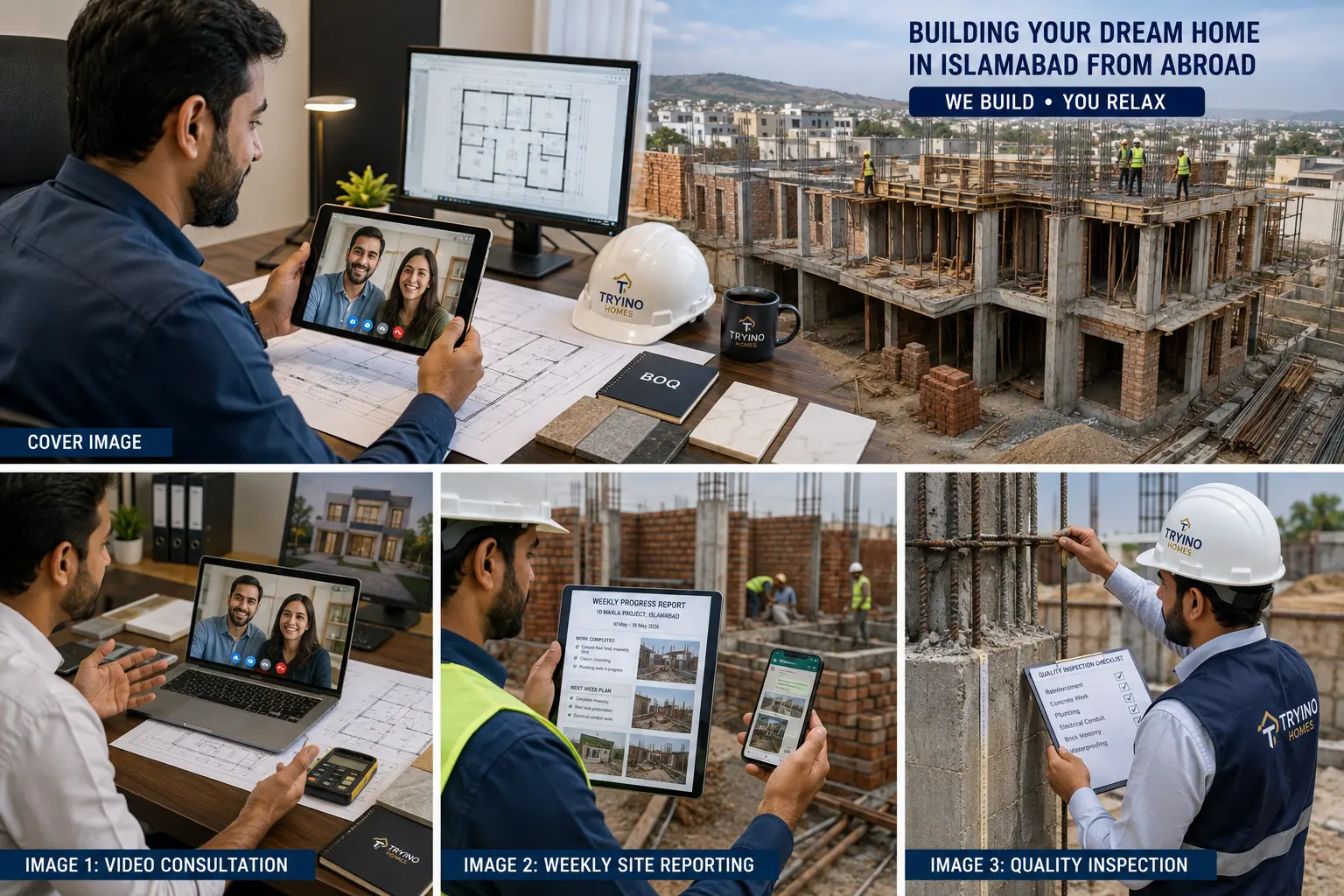
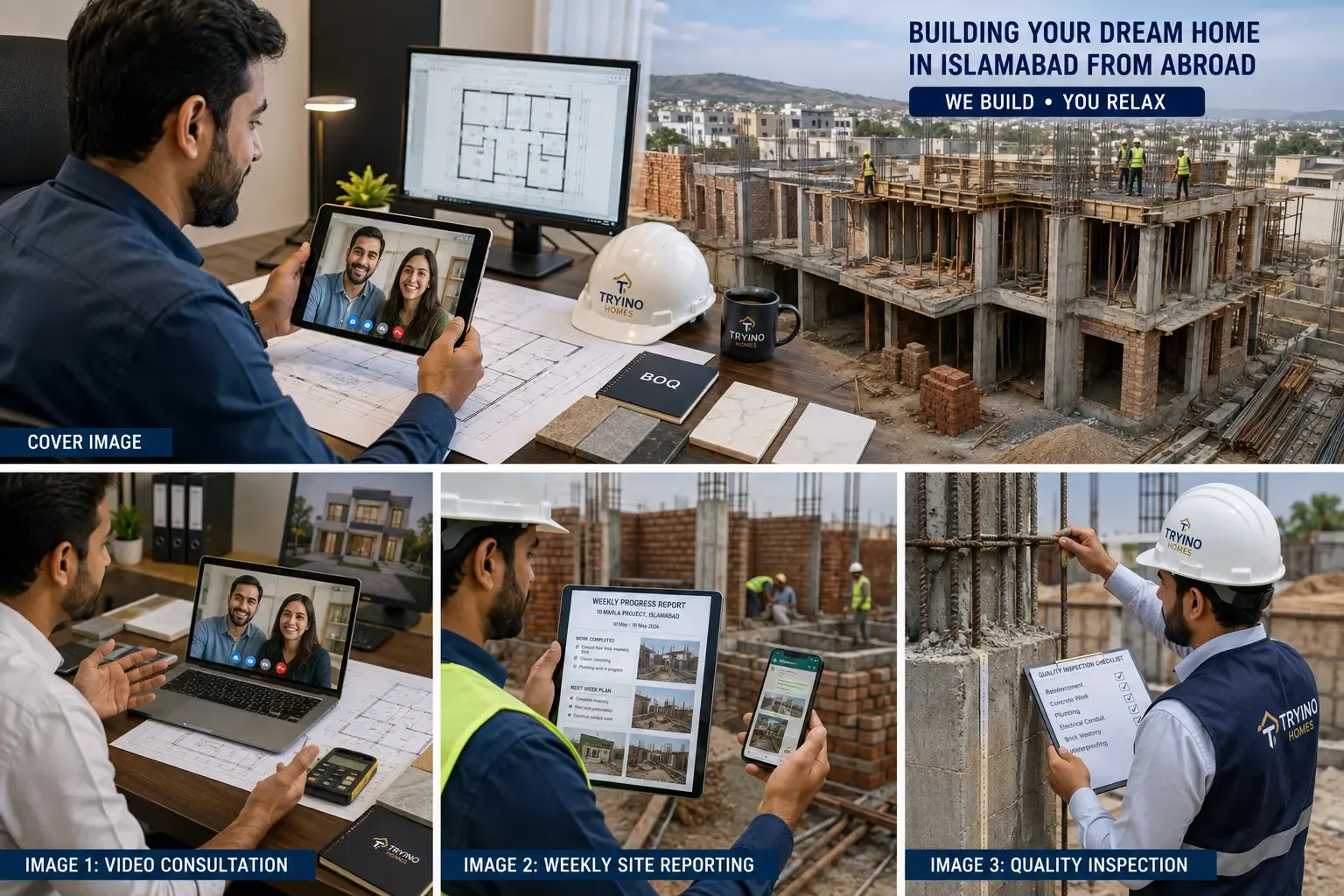
You should not need to fly to Pakistan just to explain what kind of house you want. A detailed video consultation can establish plot information, family size, bedrooms and floors, a basement or servant room if needed, kitchen and living-area preferences, parking and home-office needs, solar and smart-home requirements, design style, construction budget and expected completion target.
Tryino's overseas-owner workflow begins with an estimate followed by a video consultation scheduled around the client's timezone. The clearer the brief at this stage, the fewer expensive changes will happen later.
Step 3: Lock the Drawings and the BOQ Before You Build
Never start construction with an incomplete design. Architectural drawings settle the spaces (floor plans, elevations, sections, kitchen and bathroom layouts); structural drawings settle the engineering (foundation, columns, beams, slabs, reinforcement); and electrical/plumbing drawings settle the rough-ins (lighting and socket points, water supply, drainage, solar and smart-home provisions). Making these decisions on paper is far cheaper than changing them after brickwork or plaster.
An overseas owner should receive digital PDF copies of every drawing set and approve revisions in writing — that written record is what protects you later. See engineering drawings & design for how Tryino Homes handles this set.
The other document that matters as much as the drawings is the Bill of Quantities (BOQ) — it converts a vague construction promise into a measurable scope: cement grade, steel specification, brick quality, plumbing and electrical brands, window and tile allowances, paint system, and waterproofing. A BOQ becomes especially useful when you cannot personally inspect purchases every day. See how to vet a builder for what a real BOQ should contain.
Step 4: Choose the Right Construction Package
Overseas owners generally have three broad options.
Grey Structure
Usually covers the structural shell — foundations, RCC, masonry, roof, basic plaster and embedded MEP work. Grey structure can suit owners who plan to manage finishing later, but it means you still need to appoint or manage finishing contractors.
Semi-Finished
This sits between grey structure and full turnkey. The exact scope can vary significantly, so the contract needs to explain precisely what will be delivered.
Turnkey
A turnkey package generally takes the project to move-in condition. For overseas Pakistanis, turnkey can be easier because there is one primary contractor responsible for more of the construction journey.
Tryino Homes recommends turnkey as the default fit for overseas clients who want one contractor accountable for move-in condition; grey structure suits owners who want to stage cash flow or manage finishing separately.
Step 5: Use Milestone Payments Instead of Large Upfront Payments
One of the strongest protections in remote construction is a sensible payment structure. You should be paying against visible progress, not vague future promises.
Overseas clients use the same milestone-linked payment structure as local clients — payments are tied to completed stages and backed by invoices and site evidence.
A typical payment sequence: mobilisation, excavation and foundation, DPC/plinth, ground-floor structure, first-floor structure, roof slab, masonry, plaster and rough MEP, flooring and ceilings, woodwork and kitchen, electrical and sanitary finishing, paint, snagging, and handover. The exact percentage at each stage should be written into your contract.
Why Milestones Matter When You Live Abroad
Imagine paying a large advance for the entire grey structure. You are then dependent on the contractor to keep progressing. With milestone-linked payments, the logic changes:
Work → Evidence → Verification → Invoice → Payment → Next Stage
This creates a much healthier relationship.
Step 6: Demand Consistent Site Reporting
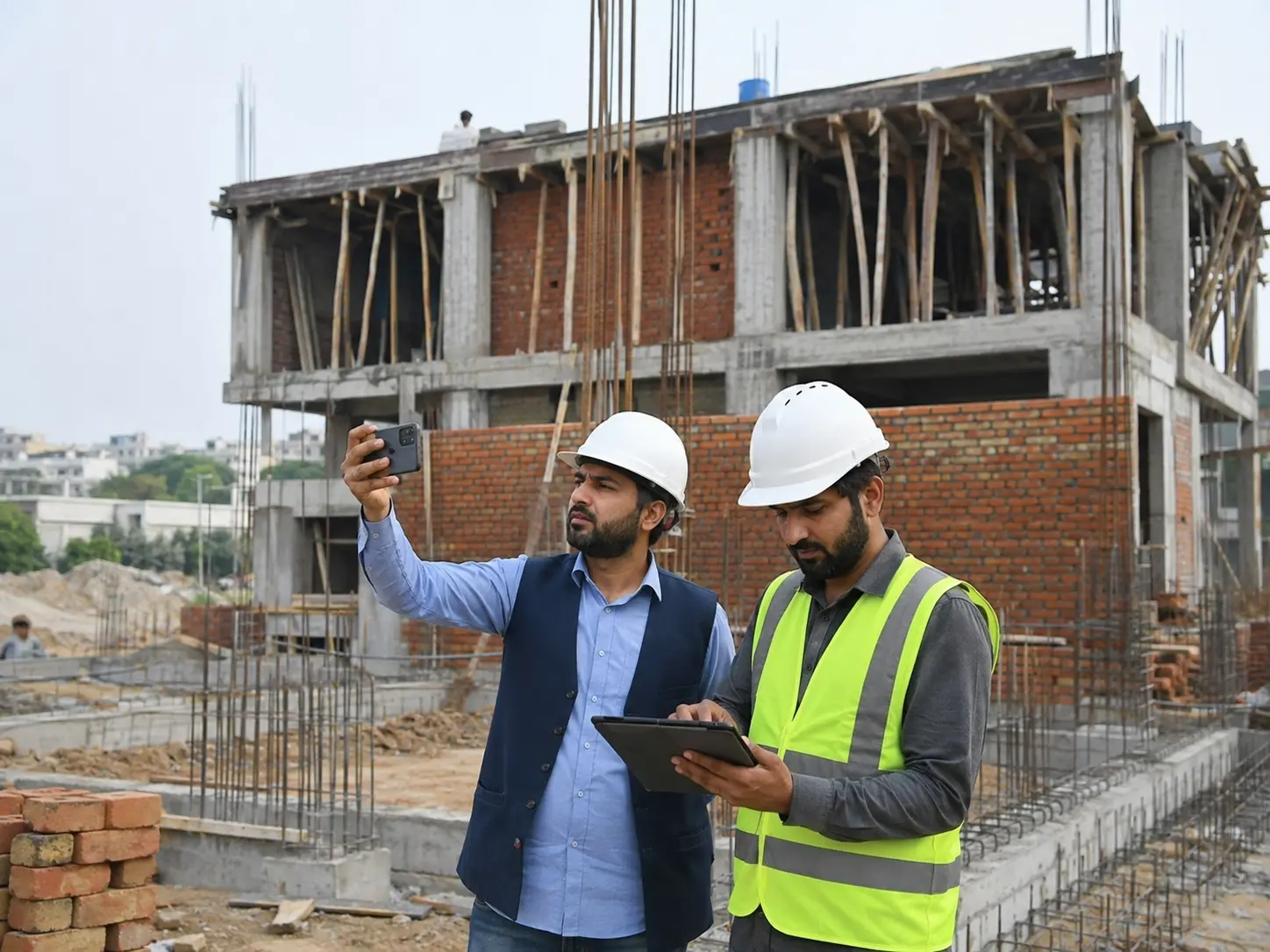
A WhatsApp photo occasionally sent by a labourer is not a construction reporting system. Regular reporting should provide enough context for you to understand progress.
Overseas clients receive weekly WhatsApp reports with site photos, milestone notes and the following week's plan.
A useful weekly report covers what was completed (for example, "ground-floor brickwork 80% complete"), photos of work areas and materials before they're concealed, any decisions you need to approve (a tile option, a window colour), next week's plan, and any delay or technical issue — documented rather than hidden.
Step 7: Have One Accountable Site Lead
A common construction problem is fragmented responsibility: the architect blames the contractor, the contractor blames the plumber, the plumber says the drawing was wrong, the supplier says nobody confirmed the material. For someone living abroad, this becomes extremely difficult to manage.
Every overseas project is assigned a named site lead and a client communication contact, so approvals and site decisions don't get lost between subcontractors. You should always know who runs the site, who sends reports, who approves work, and who is accountable if something goes wrong.
Step 8: Approve Materials Before They Are Installed
You do not need to physically visit a tile showroom for every decision, but material approvals should still be documented — brand, model, size, colour, finish, unit rate and a photo or sample comparison, for items like tiles, sanitary fittings, switches, lights, doors, kitchen hardware, countertops, paint and windows. Once approved, the selected item becomes part of the project record.
Step 9: Photograph Work Before It Gets Covered
Some of the most important construction work eventually disappears behind walls, ceilings and floors — plumbing pipes, electrical conduits, waterproofing, reinforcement, drainage, AC piping and roof treatment. An overseas owner should receive progress evidence before concealed work is covered, which also gives you a useful visual record later if a maintenance issue occurs.
Step 10: Keep Design Changes Under Control
Changes during construction are one of the easiest ways to lose control of budget and schedule. Suppose you decide to move a bathroom door after masonry is complete — the change can ripple into brickwork, plaster, electrical points, tiling, ceiling and even schedule.
For any substantial variation, ask for a written record showing:
Original scope → requested change → added/reduced cost → timeline impact → approval
Do not rely on informal phone-call approvals for expensive changes.
Step 11: Keep Important Documents in One Place
An overseas construction project creates a lot of information. Maintain a digital folder containing your property documents, drawings (architectural, structural, MEP), BOQ, contract, payment schedule and receipts, material approvals, progress reports and photographs, variation orders, society approvals, and handover documents. A clean paper trail helps protect both client and contractor.
What Should an Overseas Construction Contract Cover?
The contract should be understandable. Important sections may include:
| Contract Area | What to Define |
|---|---|
| Project Scope | Grey, semi-finished or turnkey |
| Drawings | Approved drawing set |
| Materials | Brands, quality and allowances |
| BOQ | Quantity and specification basis |
| Price | Contract value or pricing method |
| Payment | Milestone schedule |
| Timeline | Expected construction programme |
| Variations | How changes are approved and priced |
| Reporting | Frequency and method |
| Quality | Inspection/rectification process |
| Delays | Responsibility and procedure |
| Handover | Completion and snagging requirements |
| Exclusions | Items not included |
Do not assume something is included simply because it sounds "standard." Put it in writing.
Common Mistakes Overseas Pakistanis Should Avoid
Paying too much upfront
Large advances reduce your leverage. Tie payments to documented work.
Starting without complete drawings
Unresolved design decisions create site changes.
Choosing only by the lowest quote
A low rate may exclude major items. Compare scope, not just price.
Giving several relatives authority
Too many decision-makers can create conflicting instructions. Nominate one authorised representative if needed.
Changing selections repeatedly
Repeated revisions create cost and delay.
Using different contractors without coordination
Architecture, structure, electrical, plumbing and finishing need coordination.
Accepting verbal promises
Important cost, material or scope changes should be documented.
Ignoring the BOQ
Without a BOQ, it becomes difficult to know what you are actually paying for.
How Can You Check Construction Quality From Abroad?
You may not be physically present, but you can still build a quality-control process using engineer supervision, stage inspections, progress photography, video walkthroughs, material invoices, BOQ tracking and third-party inspection when needed.
Third-party inspection notes are available on request for overseas-managed projects, alongside PEC-licensed site engineering, certified materials and third-party QA.
Real Project Reporting Matters More Than Renderings
Computer-generated elevations can help you imagine the finished home. They do not prove that a contractor can build it. Look for real project evidence — actual construction photographs, completed and ongoing projects, site conditions and handover examples.
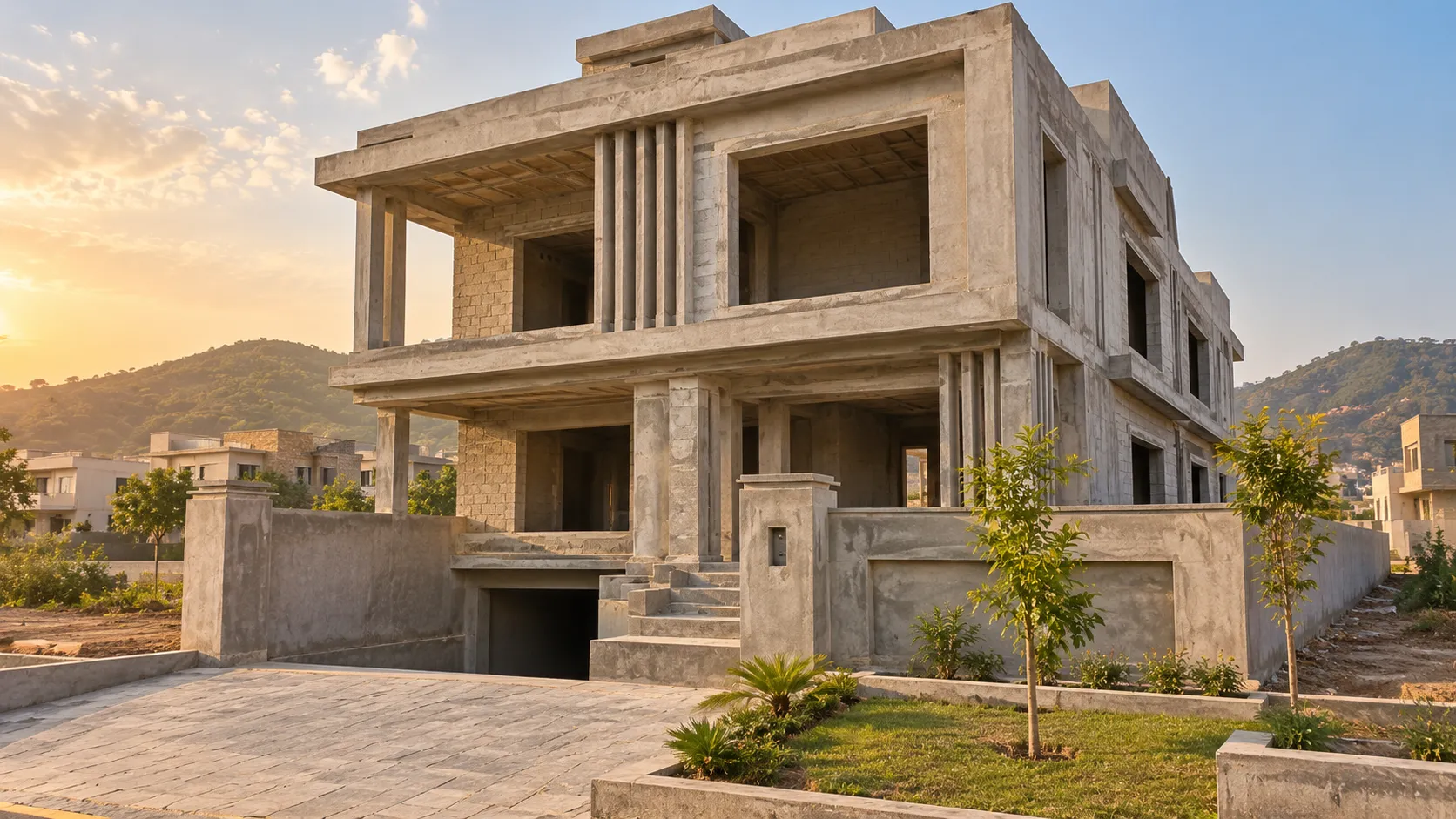
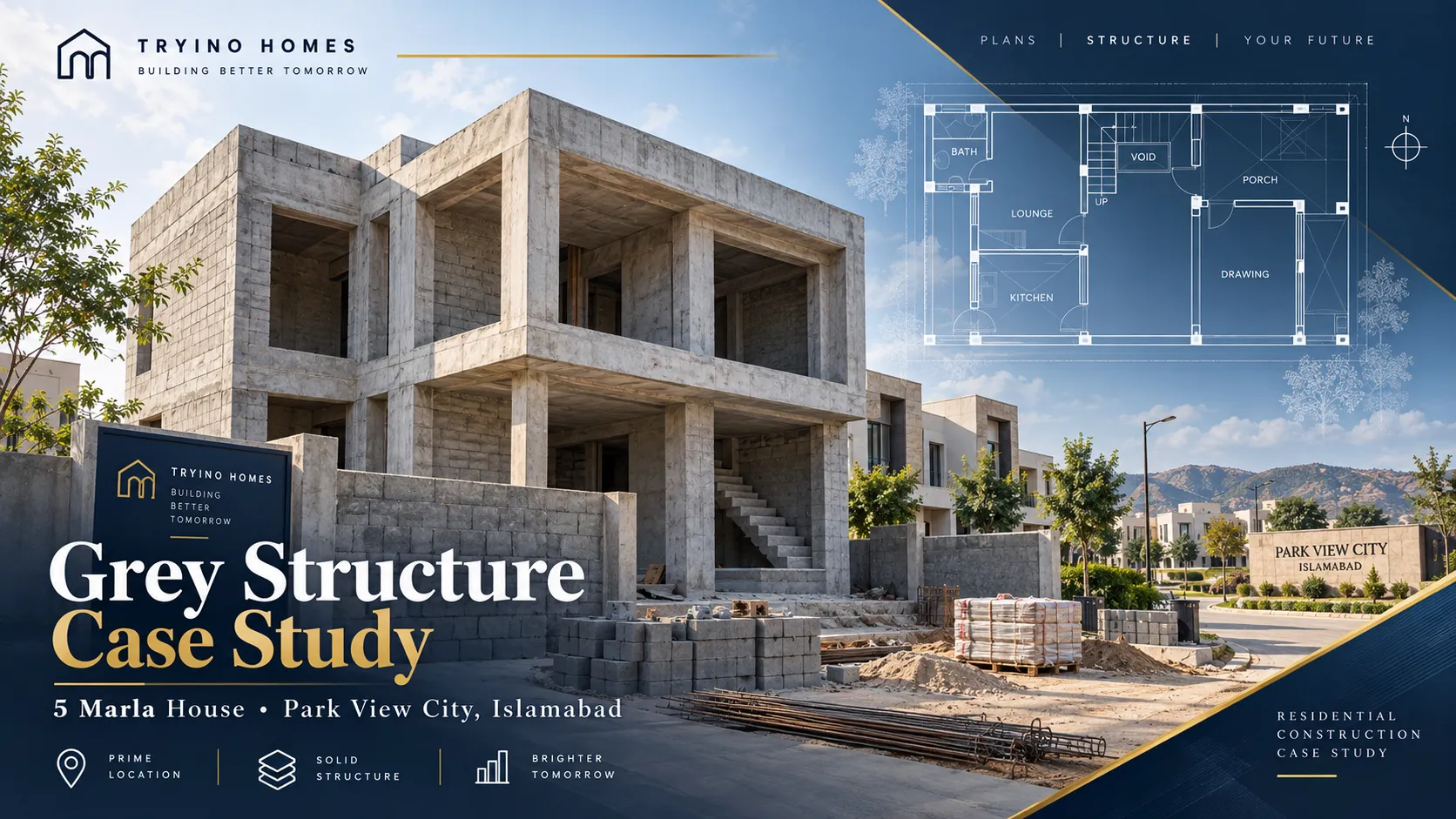
Tryino's project portfolio includes documented Islamabad-area projects — for example, a completed 5 Marla A+ grey structure in Park View City delivered against clear milestones and weekly photo reporting, and an ongoing 5 Marla project in Park View City's Overseas Block that includes piling, weekly photo updates and milestone invoices tied to visible progress.
Can You Build Without Visiting Pakistan at All?
Technically, much of the process can be managed remotely if your plot status is clear, documentation is available, drawings are approved digitally, material approvals are documented, payments are milestone-based, and reporting is consistent.
Some owners still choose to visit for major moments — the initial design meeting, material selection, a mid-project inspection, or final handover. These visits can be useful, but the construction system should not collapse simply because you cannot travel.
Tryino Homes' overseas service is built around managing construction and society paperwork without you needing to fly in for every milestone.
Which Islamabad and Rawalpindi Areas Can Overseas Owners Build In?
Tryino Homes currently serves a range of Islamabad and Rawalpindi communities, including Bahria Enclave, Bahria Town Phase 1–8, Park View City, DHA Islamabad/Rawalpindi, B-17 Multi Gardens, Faisal Town, Faisal Hills, Capital Smart City, Top City-1, DHA Margalla Enclave and Taj Residencia.
Tryino Homes most frequently handles overseas-owner projects in Bahria Enclave, Park View City, DHA and B-17. Always confirm the exact plot's possession, utility and construction status before mobilisation.
What Happens After the House Is Completed?
Remote ownership does not necessarily end when construction finishes. Before final handover, complete a structured snag inspection covering paint, tiling, doors and windows, locks, plumbing and drainage, electrical and sanitary fixtures, cabinets, waterproofing, exterior finishes and roof drainage. Prepare a written snag list — the contractor should rectify agreed items before final closure.
For owners who will not immediately occupy the home, post-handover property management for rented homes is also available to overseas owners.
A Practical Remote-Build Checklist
Before starting construction from abroad, make sure you have: verified plot ownership, possession and utilities; approved architectural, structural and MEP drawings; an agreed, detailed BOQ; a signed written contract with milestone payments; an agreed reporting frequency; one named, responsible site engineer; a documented material-approval process; defined variation/change procedures; and an agreed plan for quality inspections, snagging and handover.
If several of these items are missing, the project is not yet ready for remote construction.
Frequently Asked Questions
Can an overseas Pakistani build a house in Islamabad remotely?
Yes. With verified plot documents, approved drawings, a clear BOQ, milestone payments, site supervision and regular progress reporting, much of the construction process can be managed remotely.
How can I monitor construction while living abroad?
Use scheduled photo reports, video calls, milestone records, material approvals, invoices and live site walkthroughs. Tryino Homes currently provides weekly WhatsApp photo reports and milestone notes to overseas owners.
Should overseas Pakistanis choose grey structure or turnkey?
Turnkey generally requires less owner coordination because one contractor handles more of the project. Grey structure can work when the owner already has a reliable plan for managing the finishing stage.
How should I pay a contractor while living overseas?
A safer project structure links payments to defined construction milestones rather than large undocumented advances. The exact schedule should be written into the contract.
Do I need a relative in Pakistan to supervise the house?
Not necessarily if your builder provides professional site management, documented reporting and a clearly accountable engineer. A trusted representative can still be useful for independent checks.
How do I know the builder is using the agreed materials?
Define materials in the BOQ and request procurement records, photos, invoices or inspection evidence where appropriate. Major substitutions should require approval.
Can I approve tiles, kitchens and sanitary fittings remotely?
Yes. Contractors can share videos, photos, model numbers, supplier quotations and samples during video calls. Important selections should be documented before procurement.
What happens if I request a change during construction?
The change should be documented as a variation showing its effect on price and schedule before work proceeds.
Can Tryino Homes manage construction for overseas Pakistanis?
Yes. Tryino Homes runs a dedicated overseas-owner service for Islamabad construction — weekly photo reporting, milestone payments, WhatsApp communication, plot-status checks and a named project lead. Roughly half of Tryino's clients live outside Pakistan.
Final Takeaway
You do not need to stand on a construction site every day to build a house in Islamabad. But you do need a construction system that gives you visibility from abroad.
For an overseas Pakistani, that system should include:
Verified plot → Approved drawings → BOQ → Contract → Milestone payments → Site engineer → Weekly reporting → Material approvals → Quality checks → Snagging → Handover
Distance becomes much less of a problem when every important decision is documented and every payment is connected to visible progress.
Planning to Build in Islamabad While Living Abroad?
Tryino Homes provides grey-structure, semi-finished and turnkey residential construction across Islamabad and Rawalpindi, with a dedicated process for overseas Pakistani owners — weekly project reporting, milestone-linked payments, video consultations and a named site lead for remote clients.
Start by sharing your society, block, plot size, possession status, desired house size, construction package and approximate budget. Then establish the drawings, BOQ and construction programme before mobilisation.
Build from abroad—but keep control of the project.