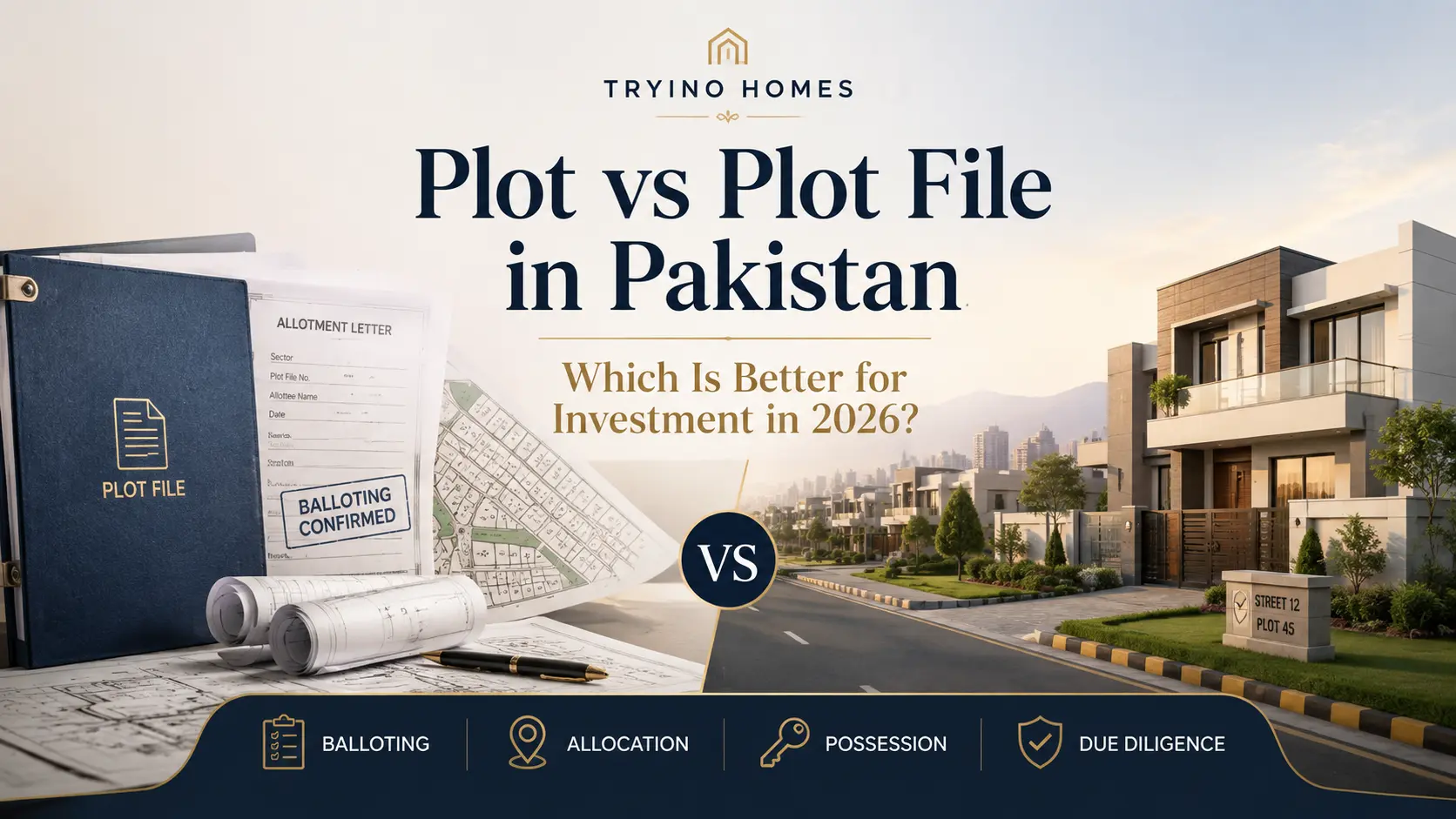
It sounds like a simple choice, but the difference can affect your investment risk, buying price, resale options, construction timeline and even whether you know exactly what piece of land you are paying for.
A plot file generally represents an entitlement or booking for a future plot in a housing scheme. A plot, on the other hand, usually refers to an allocated piece of land with an identified plot number and location.
But there is an important detail many buyers miss:
An allocated plot is not necessarily a possession-ready plot.
A property can have a plot number and map location while development, utilities or possession are still pending. That is why buyers should think of property development as a sequence rather than simply “file versus plot.”
A typical progression may look like:
Booking/File → Balloting → Plot Allocation → Development → Possession → Construction
The terminology and exact process vary between housing societies, so the documents and rules of the specific developer must always be checked.
This guide explains the difference between a plot and plot file in Pakistan, their advantages and disadvantages, risks, investment potential, due-diligence requirements and which option may suit different types of buyers in Islamabad, Rawalpindi and other Pakistani property markets.
Quick Answer: Plot vs Plot File in Pakistan
If your priority is lower entry cost and you can tolerate development and allocation uncertainty, a properly verified plot file may offer an opportunity.
If your priority is location certainty, lower development risk or eventually building a house, an allocated and preferably possession-ready plot is generally the more suitable choice.
Neither option is automatically a good investment.
A bad file in an unapproved or stalled project can become difficult to exit.
A badly located plot bought at an inflated price can also underperform.
The quality of the project, approvals, developer, location, documentation, development progress and purchase price matters more than the label “file” or “plot.”
What Is a Plot File in Pakistan?
A plot file is commonly used in Pakistan's real-estate market to describe documentation representing a buyer's entitlement to a plot of a certain size in a housing project where a specific physical plot may not yet have been assigned.
For example, a buyer may hold a file for a:
5 Marla residential plot
7 Marla residential plot
10 Marla residential plot
1 Kanal residential plot
At the file stage, the buyer may know the plot category and project but may not know the exact street, plot number or physical boundaries.
This is one reason files are commonly marketed during the early stages of housing developments.
However, “plot file” is market terminology rather than one standardized ownership instrument used identically across every Pakistani housing society.
Different projects may use terms such as:
Booking form
Registration file
Allocation file
Allotment certificate
Membership file
Affidavit file
Intimation letter
Allocation letter
A buyer should therefore verify exactly what legal or contractual right the document creates instead of assuming every document described by a dealer as a “file” offers identical rights.
What Is a Plot?
A plot normally refers to a specific piece of land that has been allocated within a housing scheme.
It generally has identifiable information such as:
Plot number
Block or sector
Plot size
Location on an approved or society-issued map
Defined position relative to streets and surrounding plots
This creates considerably more location certainty than an unballoted file.
But again, an important distinction must be made.
Allocated Plot Does Not Always Mean Possession Plot
A plot may already have a number but still be:
Under development
Without completed roads
Without utility infrastructure
Awaiting possession
Subject to outstanding development charges
Not yet permitted for construction
Therefore, someone buying property to construct a home should ask:
“Is this plot possession-ready and construction-ready?”
—not simply:
“Does this property have a plot number?”
Understanding the Property Stages
One of the easiest ways to understand file vs plot investment in Pakistan is to look at the stages separately.
| Stage | What You Generally Have | Exact Location? | Physical Possession? | Construction? |
|---|---|---|---|---|
| Booking / File | Entitlement to future property | Usually no | No | No |
| Balloted File | Plot number may have been assigned | Usually yes | Usually no | No |
| Allocated Plot | Identified plot on project map | Yes | Not necessarily | Usually not until possession |
| Developed Plot | Infrastructure may be substantially completed | Yes | Depends on society | Depends |
| Possession Plot | Physical possession offered by society | Yes | Yes | Usually possible subject to approvals |
| Construction-Ready Plot | Possession plus required permissions/conditions | Yes | Yes | Yes, subject to approved plans |
The exact terminology and sequence vary between developers, which is why buyers must verify the individual project rather than relying on generic property terminology.
What Is Balloting in Real Estate?
Balloting is the process through which a housing scheme assigns plot numbers or locations to eligible buyers.
Before balloting, a file may only represent a plot category.
For example:
10 Marla Residential File
After successful plot allocation, the buyer may receive a specific property such as:
Plot 123, Block A, 10 Marla
Balloting therefore reduces one important uncertainty: location.
But it does not automatically eliminate:
Development risk
Possession delays
Approval issues
Outstanding dues
Infrastructure delays
Market-price volatility
Balloting should therefore be seen as an important milestone—not the end of due diligence.
Plot vs Plot File: Complete Comparison
| Factor | Plot File | Allocated Plot | Possession Plot |
|---|---|---|---|
| Physical location | Usually unknown | Known | Known |
| Plot number | Usually pending | Assigned | Assigned |
| Entry cost | Often lower | Usually higher | Often highest |
| Development risk | Higher | Medium | Lower |
| Location risk | Higher | Lower | Lower |
| Construction possible | No | Usually no | Usually yes, subject to approvals |
| Site inspection | Project only | Plot can usually be identified | Plot can normally be inspected |
| Price volatility | Can be high | Moderate to high | Often more linked to on-ground demand |
| Balloting risk | Yes | No, if already allocated | No |
| Possession uncertainty | High | Can remain | Low once officially offered |
| Resale market | Can be active but sentiment-driven | Location-dependent | End-user and investor demand |
| Utility certainty | Usually low | Depends on development | Should still be verified |
| Suitable for home builder | Generally no | Only if possession is near | Usually strongest option |
| Suitable for speculative investor | Potentially | Potentially | Less speculative |
| Capital required | Usually lower | Higher | Usually higher |
| Risk level | Generally higher | Medium | Generally lower, subject to title and project risks |
This table describes typical market behaviour, not a guarantee. A possession plot in a problematic scheme may still carry substantial risk, while a file issued by a strong, properly documented development may perform well.
Pros and Cons of Buying a Plot File
Advantages of a Plot File
1. Lower Entry Cost
Files are often introduced earlier in a development cycle, which can make their purchase price more accessible than a developed or possession-ready plot.
This allows some buyers to enter a project with less capital.
2. Potential Upside Around Development Milestones
A property's market perception can change when important milestones occur, such as:
Regulatory progress
Balloting
Infrastructure development
Plot allocation
Possession announcements
An early investor may benefit if project risk decreases and market demand increases.
However, appreciation is not guaranteed.
3. Installment Opportunities
Some developers initially offer files under installment plans.
This can help buyers who do not want to deploy the full property value upfront.
4. Potentially Active Trading Market
Files in highly traded developments may sometimes change hands relatively quickly.
But liquidity should never be assumed. When sentiment weakens, file markets can also become difficult to exit.
Disadvantages of a Plot File
1. No Exact Physical Location
Before allocation, you may not know whether your future plot will be:
Near a park
On a main boulevard
Near commercial activity
On an ordinary street
In a less desirable section of the project
Location can materially affect property value.
2. Development Delays
Projects can take longer than initially expected.
Delays may result from:
Regulatory issues
Land acquisition problems
Infrastructure costs
Developer finances
Litigation
Planning changes
Broader market conditions
3. Approval Risk
A file being marketed does not prove that the development, phase or inventory has all relevant regulatory approvals.
This is particularly important in Islamabad and Rawalpindi.
4. Greater Price Volatility
A file derives much of its value from expectations about future development.
When expectations improve, prices can rise quickly.
When expectations weaken, the reverse can happen.
5. No Immediate Construction
A file does not provide a construction-ready site.
For someone planning to build a home soon, that can be a major disadvantage.
6. Dependence on Developer Execution
The file's future value can depend heavily on the developer's ability to acquire land, obtain approvals, complete infrastructure and deliver plots.
Pros and Cons of Buying a Plot
Advantages of Buying a Plot
1. Known Location
Once a plot has been allocated, you can evaluate important location factors such as:
Street width
Plot orientation
Corner status
Park proximity
Commercial proximity
Height difference
Access
Surrounding development
Nearby construction
View
Traffic exposure
These factors can significantly affect resale and end-user demand.
2. Easier Physical Verification
A numbered plot can usually be matched against the project map and inspected on the ground once sufficient development exists.
3. Lower Allocation Uncertainty
You are no longer waiting to discover which plot will eventually be assigned.
4. Better Option for Future Home Construction
A possession-ready plot provides a much clearer path toward design, approvals and construction.
5. End-User Demand
Developed plots can attract not only investors but also families looking to construct homes.
That can create a different demand profile from purely speculative files.
Disadvantages of Buying a Plot
1. Higher Purchase Price
You are often paying a premium for greater certainty.
2. Location Premiums
Corner, park-facing, boulevard-facing and other premium plots can carry additional prices.
A premium is only worthwhile if future buyers value the same feature.
3. Transfer and Holding Costs
Depending on the society and transaction, buyers may face:
Transfer charges
Government taxes
Dealer commission
Development charges
Possession charges
Membership or documentation charges
Outstanding installments
Utility or infrastructure charges
Always calculate your total acquisition cost, not merely the seller's asking price.
4. A Plot Can Still Carry Legal or Development Risk
A plot number does not automatically prove:
Clear title
Authority approval
Possession
Utilities
Construction permission
Completion of development
Plot buyers still need due diligence.
File vs Plot Investment: Where Does the Return Actually Come From?
Neither plots nor files increase in value simply because of their category.
Property appreciation normally depends on a combination of factors.
File Price Catalysts
A plot file may gain demand when:
The developer demonstrates visible progress
Regulatory uncertainty reduces
Land acquisition improves
Balloting is announced
Balloting is completed
Development work accelerates
Access roads improve
Possession appears more likely
The opposite events can reduce demand.
Plot Price Catalysts
An allocated or possession plot may benefit from:
Roads becoming operational
Utility infrastructure
Increasing occupancy
Commercial development
Schools and amenities
Better access
More home construction
Reduced nearby inventory
Stronger end-user demand
The relevant question is therefore not:
“Do files or plots make more money?”
It is:
“What future event would make this particular asset more valuable, and how likely is that event to occur?”
File vs Plot: Which Is Safer?
In general, a verified possession plot in a properly approved and developed area provides more certainty than an unallocated file.
But “plot” should never be treated as a synonym for “risk-free.”
A buyer should consider several separate risks.
| Risk | File | Allocated Plot | Possession Plot |
|---|---|---|---|
| Developer execution | High | Medium | Lower |
| Allocation/location uncertainty | High | Low | Low |
| Development delay | High | Medium | Lower |
| Regulatory risk | Depends on project | Depends on project | Depends on project |
| Market-price risk | High | Medium | Medium |
| Construction delay | Not applicable yet | Possible | Lower if approvals available |
| Documentation/fraud risk | Present | Present | Present |
| Liquidity risk | Present | Present | Present |
No investment should be described as completely safe.
Islamabad & Rawalpindi Buyers Need Extra Regulatory Verification
For file vs plot investment in Islamabad and Rawalpindi, regulatory checks are particularly important because different areas can fall under different authorities and housing-scheme arrangements.
Islamabad: Check CDA Status
For private housing schemes under relevant CDA jurisdiction, buyers should verify the development through the Capital Development Authority's current housing-scheme records.
An important point is that:
Layout Plan approval and NOC status are not necessarily the same thing.
A project may show:
LOP approved
NOC issued
NOC not issued
NOC cancelled
LOP cancelled
Other remarks or compliance issues
Do not rely on a dealer saying:
“CDA approved hai.”
Ask:
“What is the current LOP and NOC status of this exact scheme or phase?”
Rawalpindi: Check RDA Records
For properties falling under RDA jurisdiction, buyers should review the Rawalpindi Development Authority's live housing-society status.
RDA separately publishes information about:
Approved housing societies
Unapproved societies
Illegal housing societies
Public warnings and enforcement updates
This is particularly important because regulatory status can change and unofficial screenshots or old marketing material may be outdated.
Verify the Exact Phase or Block
Never assume that approval of one part of a large project automatically proves the status of every:
Phase
Extension
Block
Sector
Additional land parcel
Check the specific inventory you are buying.
Due-Diligence Checklist Before Buying a File
Before transferring money for a plot file, verify the following.
1. Relevant Authority Status
Check the current status through the relevant development authority.
2. Exact Project and Phase
Confirm that the file relates to the exact phase being marketed.
3. Developer Identity
Verify who legally issued the file.
4. File Authenticity
Confirm the file directly through the society or developer's authorized office.
5. Seller Ownership
Ensure the seller is actually entitled to transfer the file.
6. Transfer History
Review previous transfers where applicable.
7. Outstanding Dues
Ask for an official statement showing:
Paid installments
Remaining installments
Development charges
Penalties
Other outstanding amounts
8. Balloting Eligibility
Determine whether the file qualifies for any announced ballot and whether payments must be cleared beforehand.
9. Development Progress
Visit the site.
Do not judge development only through:
YouTube videos
Dealer photographs
Social-media advertisements
Computer-generated master plans
10. Land and Approval Questions
Understand whether sufficient land has been acquired and whether approvals cover the advertised inventory.
11. Transfer Procedure
Conduct the transfer through the society's authorized procedure.
12. Exit Market
Before buying, find out:
Who is likely to buy this file from me later?
An investment without an identifiable resale market can become difficult to exit.
Due-Diligence Checklist Before Buying a Plot
Plot buyers should perform all relevant checks above plus several additional checks.
Verify the Plot Number
Match the plot against the official or society-approved layout map.
Visit the Exact Plot
Check the physical location rather than evaluating only the sector.
Check Possession Status
Ask whether official possession has been offered for that plot or street.
Check Development
Inspect:
Roads
Sewerage
Electricity infrastructure
Water arrangements
Street levels
Drainage
Nearby construction
Check Outstanding Charges
Verify any:
Development charges
Possession charges
Utility charges
Transfer fees
Installments
Penalties
Confirm Construction Eligibility
If you plan to build, ask whether:
Possession has been formally granted
Building plans can currently be submitted
Society/CDA/RDA requirements have been satisfied
Utilities and site access are adequate
Hidden Cost of a Cheap Property Deal
One mistake investors make is comparing only purchase prices.
Consider your total landed cost.
This may include:
Purchase Price + Premium/Own + Transfer Charges + Taxes + Dealer Commission + Outstanding Dues + Development Charges + Possession Charges + Other Society Fees
A file that looks cheap may carry significant future payments.
A plot that appears expensive may already include some development value.
Always request a written breakdown before comparing two opportunities.
Plot File “Own” or Premium
In parts of Pakistan's property market, files and plots sometimes trade above or below their official developer price.
The market difference is commonly referred to as own or premium.
A positive premium does not necessarily mean the underlying asset is fairly valued.
Before paying a premium, ask:
What caused the price increase?
Is there a real development catalyst?
Is the premium supported by completed transactions?
Is the market mainly dealer-to-dealer?
How quickly could I resell?
What happens if the expected ballot or possession is delayed?
Avoid buying solely because someone says:
“Rate next month double ho jayega.”
Which Is Better for Short-Term Investment?
A file can sometimes offer more price movement around major project announcements and development events.
That does not make it automatically better for short-term investment.
Short-term file trading requires:
Strong liquidity
Accurate market pricing
Reliable documentation
Careful timing
Ability to absorb losses
Understanding of dealer spreads and transaction costs
If the market slows, an investor expecting a quick exit may be forced to hold the asset longer than planned.
Which Is Better for Long-Term Investment?
For a conservative long-term investor, a well-located developed or possession plot can offer advantages because its value is increasingly connected to:
Actual location
Infrastructure
Population growth
Nearby construction
End-user demand
Scarcity
But buying at the wrong price can still produce poor returns.
Long-term buyers should focus on:
quality of land + location + development + legal status + entry price
rather than simply buying whatever plot is available.
Which Is Better If You Want to Build a House?
If the objective is to start construction soon, a possession-ready plot is usually far more appropriate than a file.
Before buying, confirm that:
The plot physically exists
Possession has been offered
Construction is permitted
Required building-plan approvals can be obtained
Site access is usable
Required infrastructure exists or is reasonably available
After securing a suitable plot, homeowners can move into architectural planning, structural design, budgeting and construction.
For Islamabad and Rawalpindi homeowners, this is where Tryino Homes' Construction & Development services and Construction Cost Calculator can help turn the land purchase into a realistic project budget.
Which Is Better for Overseas Pakistanis?
Overseas Pakistanis often have different priorities from local speculative traders.
Distance makes independent verification particularly important.
An overseas buyer should ideally prioritize:
Clear documentation
Authority verification
Direct society confirmation
Traceable payments
Location evidence
Written due diligence
Reliable representation
Defined exit strategy
A lower-priced file can look attractive online, but buyers should be cautious about relying entirely on WhatsApp groups, YouTube videos or sales agents.
Tryino Homes' Investment Consultancy service is designed for buyers who want society, file and asset due diligence before deploying capital in Islamabad or Rawalpindi.
File vs Plot: Which Buyer Does Each Suit?
| Buyer Type | Usually More Suitable | Why |
|---|---|---|
| Planning to build within 1–2 years | Possession plot | Location and construction certainty |
| Conservative investor | Developed/possession plot | Lower development uncertainty |
| Higher-risk investor | Verified file | Earlier entry and development exposure |
| Limited initial capital | File/installment inventory | Potentially lower entry requirement |
| Overseas buyer prioritizing certainty | Verified allocated/possession plot | Easier asset verification |
| Investor seeking development-stage upside | File or early allocated plot | Exposure to future milestones |
| Family buying future home site | Allocated/possession plot | Can evaluate exact neighborhood |
| Pure short-term trader | Depends on liquidity | Market depth matters more than asset label |
This is a general framework, not personalized investment advice.
Example: When a File May Make Sense
Consider an investor who:
Has surplus capital
Does not need to build
Can hold for several years
Understands speculative risk
Has verified the scheme
Has checked the developer
Has independently confirmed the file
Can tolerate delays
A properly investigated file could fit that mandate.
The investor is knowingly exchanging certainty for earlier-stage exposure.
Example: When a Plot Makes More Sense
Now consider a family planning to build a 10 Marla house.
They want to begin architectural design within months.
Their priorities are:
Exact location
Road access
Utilities
Neighborhood development
Building permission
Cost planning
For that buyer, saving money by purchasing an unballoted file may solve the wrong problem.
A suitable possession-ready plot is generally much more aligned with the objective.
Common Mistakes When Buying Files or Plots
Buying Because Everyone Else Is Buying
Market excitement is not due diligence.
Trusting Only the Dealer
A property dealer can help facilitate a transaction, but buyers should independently confirm important information.
Checking Society Approval but Not the Phase
Approval status can be more specific than the society's brand name.
Assuming Balloting Means Possession
Balloting and possession are separate milestones.
Assuming Plot Means Construction-Ready
A numbered plot may still be under development.
Ignoring Outstanding Dues
Cheap asking prices can hide significant future charges.
Buying Without an Exit Plan
Before entering, know what would make you sell.
Focusing Only on Expected Profit
Always ask what could go wrong.
Questions to Ask Before Paying a Token
Before giving even a token amount, ask:
What exactly am I buying: file, balloted plot, allocated plot or possession plot?
Who issued the original document?
What is the current authority status?
Does that status apply to this exact phase/block?
Can the document be verified directly?
Is the seller the current recorded owner?
Are all installments cleared?
Are development charges outstanding?
Is the property eligible for transfer?
What are the transfer charges?
Has balloting occurred?
Has possession been offered?
Can I physically visit the plot?
Is construction currently permitted?
What is the current realistic resale market?
What comparable transactions support the asking price?
If the seller or agent becomes uncomfortable when you ask these questions, that itself is useful information.
So, Is a Plot Better Than a Plot File?
There is no universal winner.
A plot file generally gives you:
Lower entry price + higher uncertainty + exposure to future development milestones.
An allocated plot generally gives you:
Known location + greater certainty + continued development/possession risk.
A possession plot generally gives you:
Known land + greater physical certainty + a clearer route toward construction.
The right option depends on your:
Budget
Investment horizon
Risk tolerance
Liquidity needs
Construction plans
Location preference
Ability to perform due diligence
The best property is not automatically the cheapest file or the most expensive plot.
It is the property where the risk, documentation, location, price and exit strategy make sense together.
Frequently Asked Questions
What Is a Plot File in Pakistan?
A plot file generally represents an entitlement or booking for a plot in a housing project before a specific physical plot has been allocated. Exact rights and terminology vary by developer, so the original documents should always be verified.
What Is the Main Difference Between a Plot and a Plot File?
A file generally represents future plot entitlement, whereas an allocated plot has an identified plot number and location.
Is Buying a Plot File Safe in Pakistan?
It can carry significantly more uncertainty than a possession plot. Safety depends on regulatory status, developer credibility, documentation, project development, file authenticity and the price paid.
Can I Build a House on a Plot File?
No. A file does not normally provide a possession-ready construction site. The property generally needs to be allocated, developed and formally opened for possession/construction first.
Does Balloting Mean I Own a Possession Plot?
Not necessarily. Balloting can assign a plot number while development and possession remain pending.
What Is a Balloted Plot?
A balloted plot is one where a specific plot number or location has been assigned through the developer or society's allocation process.
What Is a Possession Plot?
A possession plot is one for which the relevant society or developer has formally offered physical possession, subject to its applicable requirements and outstanding dues.
Is a Plot File Cheaper Than a Plot?
Files are often cheaper because buyers accept more location, development and possession uncertainty. This is a general market tendency rather than a rule.
Which Is Better for Investment: File or Plot?
For investors comfortable with higher uncertainty, a properly verified file may provide earlier-stage exposure. Buyers seeking greater location and development certainty may prefer an allocated or possession plot.
Which Is Better for Building a House?
A possession-ready plot is generally the better option because it provides a specific site and a clearer route to construction.
How Do I Verify a Housing Society in Islamabad?
Check the current regulatory information published by the Capital Development Authority and verify the exact scheme, phase and approval status instead of relying on marketing claims.
How Do I Verify a Housing Society in Rawalpindi?
Check the current Rawalpindi Development Authority housing-society records and verify whether the project is listed as approved, unapproved or illegal under the applicable jurisdiction.
What Should I Check Before Buying a Plot File?
Verify authority status, developer identity, file authenticity, transfer history, dues, ballot eligibility, development progress, transfer procedure and the realistic resale market.
Is a File Good for Overseas Pakistanis?
It can be, but distance makes independent verification even more important. Overseas buyers should avoid relying solely on marketing material and should obtain current society, documentation and asset checks before transferring funds.
Planning to Buy a Plot or File in Islamabad or Rawalpindi?
Do not start with:
“Which property will give me the highest return?”
Start with:
“What exactly am I buying, what could go wrong, and how do I verify it before paying?”
Tryino Homes' Investment Consultancy service reviews plots, files and property opportunities using society checks, location analysis, documentation questions, comparable pricing, risk assessment and exit considerations.
If you already own a possession plot and are planning to build, Tryino Homes can also help you move from land evaluation to construction budgeting, architectural planning and house construction.
Buy the paperwork you understand.
Buy the risk you can afford.
And verify both before you transfer the money.